
Introduction
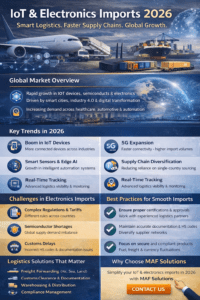
In 2026, markets all around the world will need more electronic parts, semiconductors, and IoT devices very quickly. The Internet of Things (IoT) ecosystem is growing because of smart homes, industrial automation, connected autos, and wearable gadgets. This makes it much more important to have good, reliable logistics for imports.Companies rely on suppliers from other countries a lot, therefore bringing in IoT devices, sensors, and electrical modules is becoming a very important part of global logistics and supply chain operations.You not only have to move these goods, but you also have to keep an eye on customs clearance, following the laws, paperwork, and the supply chain.Businesses have to deal with big logistics concerns including certifications, cybersecurity constraints, and problems with the global supply chain to make sure that their imports go smoothly and are lawful.It’s important to stay up to date on the newest news regarding improvements in logistics for IoT and electronics imports in 2026 so that things run smoothly, you save money, and there are less delays.Important Changes in Logistics for Electronics and IoT Imports in 2026
1. Logistics needs more and more IoT semiconductors
As IoT technologies increase swiftly, the need for semiconductor imports grows as well. This puts more stress on global logistics networks.By 2026, the IoT semiconductor industry is expected to be worth $682.49 billion. This means that there will have to be good ways to move, store, and manage goods.Logistics companies are very important to businesses like these:- Building the infrastructure for smart cities
- Devices that you can wear to track your health
- IIoT for corporate predictive maintenance
- Transportation and car systems that can communicate with each other
2. Building more logistical infrastructure for 5G
As 5G networks spread over the world, more people want gadgets that can connect to the internet quickly, which is bad for IoT logistics.This has caused a massive increase in the number of IoT modules, sensors, and edge computing devices that enter into the country. This means that delivery options need to be quicker and more dependable.Now, logistics operations need to be able to do these things:- Watching shipments in real time
- Processing at customs goes faster
- Travelling between borders is quick and straightforward
- Less time spent in transit for goods that need to get there quickly
3. Edge AI and smart sensors are becoming more common, thus they need special logistics
Smart sensors and Edge AI devices are becoming increasingly widespread, which is changing what logistics demands are.You need to be very careful when you use these new tools. Make sure they can be moved safely and follow international safety requirements.Companies like this need logistics solutions that work:- Systems for automated manufacturing
- Things that help you keep an eye on your health
- Technologies for smart farming
- Ways to watch the environment
4. More IoT devices are being sold in developing markets
Countries that are still developing, like India, are quickly adopting IoT technologies.By 2026, the Indian IoT market is expected to be worth $26.9 billion. This would make logistics for imports much more important.This growth is due to the following:- Plans for Industry 4.0
- Projects for digital transformation
- Putting together smart infrastructure
- Gateway to the Internet of Things
- Parts that are already there
- Business sensors
- Things to keep an eye on
Issues with importing electronics and IoT: following the requirements and gaining the proper certifications
When you import IoT devices into the country, you must follow tight rules about safety, wireless communication, the environment, and cybersecurity.Before their goods get to customs, logistics companies need to make sure that they all meet compliance criteria.Problems in the supply chain
There are still problems in the electronics sector, like:- There aren’t enough semiconductors
- Trade limits all around the world
- Holds up shipping and making things
Rules for cybersecurity in logistics
Governments are making cybersecurity rules harsher as more devices connect to the internet.To meet regulatory requirements, logistics companies must ensure that they safely handle and document electronic imports.Getting through customs and figuring out HS codes
It’s very important to have the HS codes perfect when you bring electronics into the country.Because many IoT goods include more than one portion, putting them in the wrong category can cause complications.- Delays at customs
- Fines
- Wrongly calculating duties
The best ways to handle logistics for bringing in gadgets and the Internet of Things
- Before sending anything, make sure that all of the products have the right approvals and certificates
- Pick logistics and customs clearance companies that have been in business for a long time
- To lower the risk of relying too much on one vendor, make sure your supplier networks are diverse
- Keep good records of technical and compliance papers
- When choosing gadgets, make sure to put safety and cybersecurity first
- Paperwork and getting through customs
- Sorting out customs and doing duties
- Shipping and forwarding goods
- Taking care of the entire supply chain