

Businesses that trade around the world need good warehousing solutions in today’s fast-growing global market. Businesses may better meet consumer expectations, cut costs, and make the supply chain run better by properly storing, managing, and distributing their goods. If you want to grow your business, no matter how big or little it is, you need to know how to warehouse for global trade.
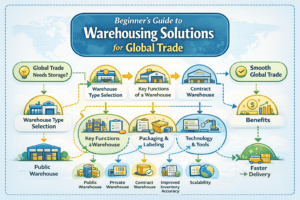
1. Learn about the many kinds of storage options
Businesses all across the world use many types of warehousing systems:
- Public warehouses: Places where many enterprises can share space. They are great for tiny or seasonal firms.
- Private Warehouses: A firm owns and runs them, thus they have full control over the goods.
- Bonded warehouses: Safe places to store imported products that haven’t cleared customs yet.
- Third-Party Warehouses (3PL): Companies who store your stuff and fill your orders.
Choosing the proper type makes sure that storage is quick and easy and shipment around the world goes well.
2. Why it’s important to choose the right location for your warehouse
The location of your warehouse influences how quickly and how much it costs to ship:
- Close to big cities, airports, or ports so that things can move more quickly
- Regional distribution facilities make it possible to supply quickly to customers in the area
- When warehouses are in the right places, it’s easier to keep track of inventories
A good location for a warehouse helps trade grow around the world and lowers expenses.
3. Keep a close eye on your stock
For global warehousing, keeping track of your inventory is very important:
- Using warehouse management systems (WMS) to see stock levels in real time
- Don’t have too much or too little stock
- Use sales trends in different areas to predict demand
Good inventory management makes sure that things are always ready to be shipped on time.
4. Use machines and technology
Technology and automation are used in modern warehouses:
- RFID, barcode scanning, and systems for picking items automatically
- Connect WMS to your e-commerce or ERP platforms
- Use analytics to keep an eye on how well your warehouse is doing
Automation makes things run more smoothly, cuts down on mistakes, and makes the supply chain more accurate.
5. Follow the guidelines for trading with other countries
Customs and international rules must be followed by warehouses that handle worldwide trade:
- Correctly identifying and documenting commodities that are brought into or sent out of the country
- Correct HS codes and duties
- Following safety and storage standards for certain goods
Following the rules keeps shipments from being late, getting fined, or being turned down.
6. Look at how easy it is to alter and grow
As your business expands, your storage needs may change:
- Pick warehouses that can manage peak or seasonal demand
- Increase storage space without affecting operations
- Use 3PL technologies to make your logistics more flexible and scalable
Flexible warehousing makes it possible for businesses to grow around the world without any problems with shipping.
Last Thoughts
For global trade to be successful, it needs good warehousing solutions. By choosing the right type of warehouse, putting it in the right place, managing inventory well, using automation, following the rules, and making sure the warehouse can grow with the business, businesses can make their supply chain more efficient and keep consumers happy.
MAF Solutions helps businesses grow abroad by providing professional storage, inventory management, and logistics support. Their knowledge makes sure that things are stored, tracked, and dispatched in a way that helps businesses do well in global trade.