

It’s always been necessary to manage the supply chain by predicting inventory. How much stock to keep, when to reorder, and how demand will change all have a direct effect on costs, customer satisfaction, and business performance. But traditional forecasting systems sometimes rely on past data and guesswork, which can be challenging to keep up with in today’s fast-paced industry.
AI is having a huge impact here. AI is transforming how we guess what we have in stock by looking at vast amounts of data in real time to make it smarter, more accurate, and more responsive.
1. Going Beyond Old Information
Most of the time, traditional inventory forecasting uses prior sales to guess what consumers would desire in the future. This strategy is useful, but it doesn’t always work when the market changes quickly or when demand is hard to figure out.
AI-based forecasting models look at a lot of various data sources at once, like:
- Data on historical sales
- How people buy stuff
- Patterns of demand by season
- Market and sales trends
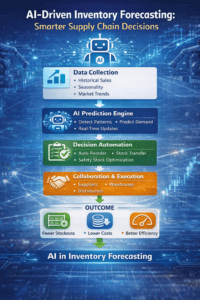
AI finds patterns that are hard for people to detect, which helps it generate better and more flexible predictions. This helps businesses figure out how much to keep in stock.
2. Reducing the Number of Times You Run Out of Stock or Have Too Much of It
One of the hardest parts of managing inventories is keeping the right balance. If you run out of a product, you lose sales and make customers unhappy. You have to pay extra to store and trash away things when you have too much of them.
AI helps with this in the following ways:
- More accurately projecting changes in demand
- Recommending the ideal amounts to order again
- Changing stock levels automatically based on expected demand
Because of this, things are easier to get, holding costs are cheaper, and there is less waste throughout the supply chain.
3. Changes to Predictions in Real Time
Unlike previous techniques of making predictions, AI systems are always learning and changing their predictions.
For example:
- If there is a big increase in online orders, the predictions will be changed right away
- Reorder planning takes into consideration delays from suppliers
- People look to marketing campaigns to see how they could change demand
Businesses can quickly deal with unexpected events and keep things operating smoothly because they may change in real time.
4. Considering External Factors Beyond Control
AI can take into consideration elements that are out of your control that manual forecasting methods sometimes miss. These things might be:
- The weather affects how many people desire to buy something
- Changes in the economy that change the way people shop
- Items that happen on social media that make consumers want to buy items right away
By combining data from inside and outside the organization, AI helps planners see future demand more clearly and completely. This makes things less uncertain.
5. Automatically Making Choices About Inventories
AI does more than just guess what people desire; it also helps computers make decisions on their own.
Many inventory systems that use AI can:
- Set up automatic purchase orders
- Suggest shifting supplies from one warehouse to another
- Keep safety stock levels as low as you can
This makes it less likely that individuals will have to get involved, minimizes the likelihood of making mistakes, and allows supply chain teams to prepare for the future instead of executing their daily tasks.
6. Making It Easier for People in the Supply Chain to Work Together
AI-based tools for predicting the future make it easy for everyone in the supply chain to talk to each other. Sharing information about data helps suppliers, warehouses, and distributors work together better.
Some good things are:
- Working better with suppliers
- Less uncertainty about how long it will take
- Better planning in a number of sites
The complete supply chain works better and more reliably when people work together better.
Conclusion
In conclusion, AI is changing the way firms make huge predictions about their stock. AI replaces guesswork with data-driven insights, which makes inventory management more precise, adaptable, and efficient.
Companies that employ AI-powered forecasting can gain ahead of their competitors by cutting costs, providing better service, and being able to react more swiftly to changes in the market. AI-driven inventory forecasting is no longer just a dream for the future; it’s becoming a need as supply chains get more intricate and customers want more.