

Opening
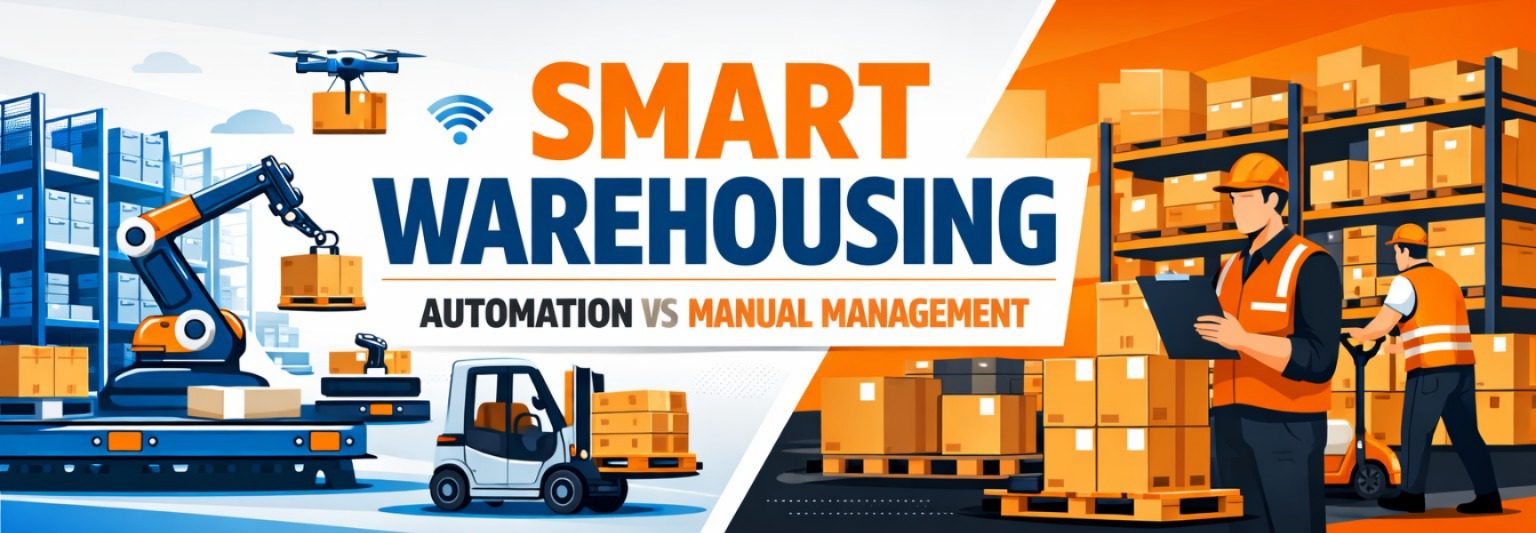
It’s not just about storing items anymore when it comes to warehousing. In today’s fast-paced supply chain, warehouses are very important for speeding up order fulfillment, making sure that inventory is accurate, and improving overall operational efficiency. Businesses are faced with a key choice as customer expectations rise and volumes rise: continue to manage their warehouses by hand or invest in smart, automated technologies for warehousing.
To construct efficient, scalable, and future-ready warehouse operations, Modern Automated Freight (MAF) needs to know how to find the right balance between automation and manual management.
What Is Smart Warehousing?
Smart warehousing means using automation, digital systems, and data-driven technology to run a warehouse more smoothly. These systems combine technology and software to make tasks like receiving, storing, choosing, packaging, and shipping easier.
Smart warehousing uses a lot of different technologies, such as:
- Systems for managing warehouses (WMS)
- Automated storage and retrieval systems (AS/RS)
- Robotics and conveyor systems
- Tracking with barcodes and RFID
- Analytics for inventories driven by AI
- Sensors that work with the Internet of Things
Smart warehouses want to make things faster, more accurate, and easier to see while cutting down on the need for people to do things by hand.
A Look at Manual Warehouse Management
People do a lot of the work that goes into running a manual warehouse every day. People commonly use paper-based methods or simple digital tools to keep track of inventory, pick items, pack them, and keep records.
Benefits of Managing by Hand
- Less money needed up front
- Easy to set up and use
- Works well for small businesses
- You can make quick changes without the system getting in the way
Problems with Manual Management
- More likely to make mistakes
- Longer processing times
- Inventory visibility is limited
- Hard to grow operations
- More expensive labor over time
As order quantities rise, manual warehouses typically have a hard time keeping up with the needs of today’s supply chain.
How Automated Warehousing Works
Automated warehousing uses machines and smart systems to do the same chores over and over again that need to be done quickly. These systems are made to work quickly and consistently with as little help from people as possible.
Normal Functions of an Automated Warehouse
- Receiving and sorting commodities automatically
- Picking and packing using robots
- Moving things with a conveyor belt
- Tracking inventory in real time
- Automated combining of orders
- Scheduling dispatches based on the system
Automation makes it possible for warehouses to run around the clock with great accuracy and efficiency.
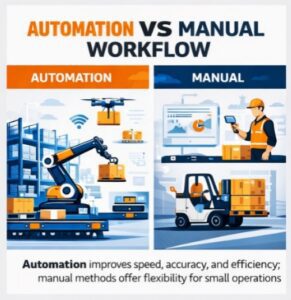
Key Comparison Aspect: Automation vs. Manual Management
Aspect | Manual Management | Automated Storage |
Cost in the Beginning | Low | High |
Speed of Operation | Slow to Moderate | Very Accurate |
Accuracy | Depends on work | Highly accurate |
Scalability | Limited | Very easy to scale |
Dependence on Work | High | Low |
Inventory Visibility | Limited | Real-time |
Error Rate | Higher | Minimal |
Long-Term Cost | Increases with time | Optimized over time |
Smart Warehousing Benefits for MAF
- Better efficiency in operations
Automation speeds up the processing of incoming and outgoing shipments, which speeds up order fulfillment and increases throughput. - More accurate and fewer mistakes
Processes that are driven by a system get rid of a lot of mistakes that people make when picking, labeling, and updating inventory. - Better control of inventory
Real-time tracking makes ensuring that stock levels are correct, which cuts down on overstocking and stockouts. - Increased Productivity of the Workforce
People who work in human resources can be moved from doing the same thing over and over again to doing jobs like planning, supervising, and quality control. - Scalability for Growth
Automated solutions let warehouses handle more goods without raising labor costs by the same amount.
When It’s Still a Good Idea to Manage Things by Hand
Even if automation has its benefits, manual warehousing is still useful in several situations:
- Small or low-volume storage facilities
- Handling of specialized or unusual goods
- Needs for short-term or seasonal storage
- Companies that don’t have a lot of money to invest
In these situations, a hybrid method that combines manual work with selective automation often works best.
The Hybrid Warehouse Model: The Best of Both Worlds
Many modern warehouses utilize a mix of automation and human control. For instance:
- Automated inventory tracking with picking by hand
- Robotics for high-volume SKUs and handling by hand for delicate products
- WMS with AI and people making decisions
This method gives you options while slowly moving toward full automation.
The Future of Smart Warehousing
Smart warehouses will grow smarter, more connected, and more independent as technology improves. AI-powered forecasting, predictive maintenance, and fully robotic fulfillment centers will change how warehouses work.
For logistics companies like MAF, investing in smart warehousing isn’t just about being more efficient; it’s also about getting ahead of the competition in a supply chain that is becoming more automated.
Conclusion
The decision between automated and manual warehouse management depends on the size, volume, budget, and long-term goals of the organization. Manual administration is easier and costs less at first, but automation gives modern supply chains the speed, precision, and ability to grow that they need.
Smart warehousing helps logistics companies stay flexible, cut costs, and satisfy client needs with certainty. Businesses can make their warehouse operations effective now and ready for the future by finding the correct mix between automation and human knowledge.