Introduction
Countries are trading more and more, and corporations are transporting goods across borders faster than before. Customs clearance has always been one of the hardest and most time-consuming phases of transporting goods from one country to another. Regulatory checks, compliance inspections, and paperwork done by hand can all slow things down, cause mistakes, and raise costs.Because of the use of both artificial intelligence (AI) and automation technology, customs procedures are changing in 2026. These technologies are making international trade go more easily for logistics companies, customs inspectors, and corporations. They range from automated document checks to complex risk evaluations.New Ideas for Customs Clearance
Customs clearance is a long process that includes checking papers, figuring out the right tariff, calculating duties, making sure everything is in order, and looking at the package. A lot of these jobs used to have to be done by hand, which might make things more difficult.Some of the problems that happen are:- A lot of paperwork to ship
- Strict procedures for bringing goods in and out
- When people filter or enter data, they could make mistakes
- Delays because to checking by hand
- People are dealing more all across the world
How AI helps in getting through customs
Going through papers On its own
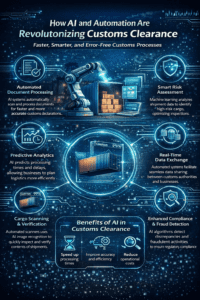
AI systems can automatically check shipping papers including packing lists, bills of lading, and business invoices. These systems use optical character recognition (OCR) and machine learning together to quickly find and check important information.This makes it easier to type in information by hand and speeds up the process of mailing in customs forms.Grouping of Smart Tariffs
Getting the right HS code is very important for figuring out how much taxes and fees you owe. AI systems can read product descriptions and propose the best way to classify them for tariffs. This lowers the chance that you’ll make a mistake and get a fine.Finding fraud and figuring out how dangerous it is
Customs inspectors are utilizing AI-powered risk assessment tools more and more to find things that are very likely to be problematic. AI can find similarities in past transaction data that might point to fraud, false reporting, or problems following the rules.This lets inspectors look more closely at shipments that seem suspicious while letting cargo that isn’t a risk pass through faster.Using Predictive Analytics to Plan Shipments
AI systems can look at data about shipping and receiving to figure out what might cause delays, issues with customs, or issues with following the regulations. Businesses can utilize this information to better manage their shipments and avoid problems.How automation is making it easier for customs to do their job
Documents sent in faster
Automated customs systems enable companies submit in documents electronically, which saves time and paperwork that would have been wasted if people had to do it by hand.Watching shipments in real time
Automation technology keep you up to date on how your shipment, customs approvals, and clearing are all moving in real time. This lets businesses and logistics companies keep an eye on the supply chain.Less time needed to get things done
Automation makes it faster to clear goods by reducing down on the time it takes to run duty calculations, check papers, and make sure everything is in order.Connecting to logistics systems
Modern logistics platforms combine customs software, freight systems, and warehouse management systems into one digital process. This helps the supply chain run smoothly.The pros of employing AI and automation to get through customs
Businesses that use AI-powered customs solutions can get a lot of benefits.- Faster customs clearance
- Fewer mistakes on paperwork
- It costs cheaper to run the business
- Better following of the rules
- More openness in the supply chain
In the Future: Customs Clearance
More and more customs work will be done online in the future. Governments and logistics companies are spending money on things like AI-powered trade compliance solutions.- Blockchain for keeping records safe
- Automatic ways to check cargo
- Digital versions of customs forms
How MAF Solutions makes it faster to get through customs
We help businesses who do business all over the world cope with customs when they import and export items by using our knowledge of logistics and the newest technologies.We offer these services:- Getting products through customs when they come in and depart out
- Help with regulations and forms
- Shipping and handling of goods
- Taking care of the supply chain and logistics
- Dealing with cargo and rules that are hard to understand